
Stainless steel wins on wholesale margins for most boutique retailers and DTC brands because it costs less to source at scale, resists tarnish without replating, and drives fewer maintenance-related complaints and returns. Sterling silver still has a place in premium or fine-jewelry positioning, but its higher base cost and ongoing tarnish maintenance quietly erode the margin advantage many retailers assume it has. For sellers optimizing for margin and low return rates, 304 stainless steel is the structurally stronger material to stock as your core catalog.
MFCHIC, a 304 stainless steel jewelry manufacturer with 16 years of export experience, works with boutique and DTC buyers making exactly this stocking decision every day — this guide breaks down where each material actually helps or hurts your bottom line.
Why Material Choice Is a Margin Decision, Not Just a Style Decision
Retailers often frame stainless steel vs. sterling silver as a style or “perceived value” question. In practice, it’s a cost-structure question that plays out over the full life of a SKU — not just at checkout.
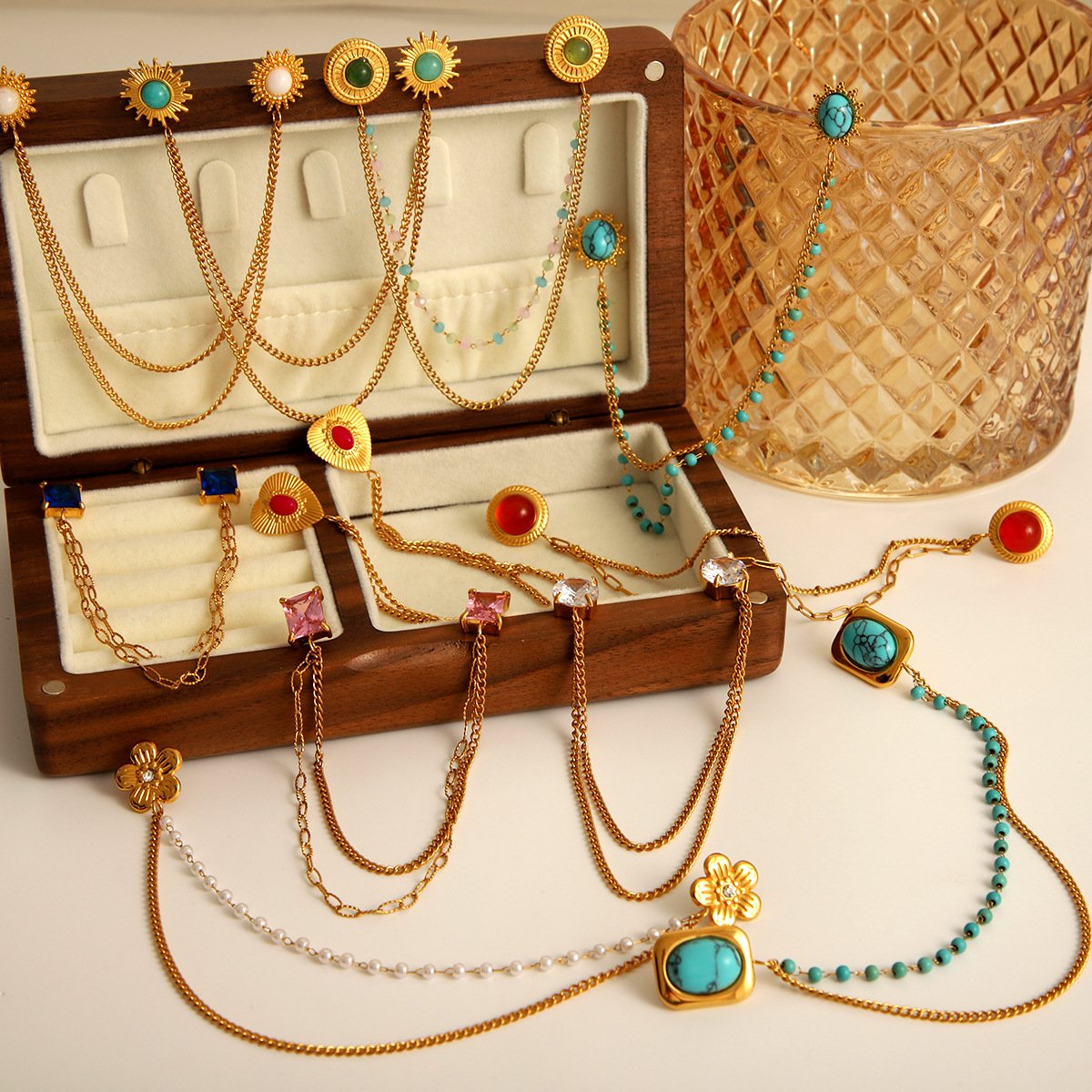
Stainless steel jewelry from MFCHIC’s in-stock catalog ranges roughly $0.4–$6.0 per piece depending on category (necklaces $1.2–$5.0, bracelets $0.9–$4.0, earrings $0.6–$3.0, rings $0.5–$2.5), with a 10-piece-per-style MOQ that lets you test styles before committing to volume. Sterling silver, as a precious-metal alloy (typically 92.5% silver), carries a materially higher and more market-volatile base cost — its price moves with global silver markets, which stainless steel’s non-precious-metal composition simply doesn’t.
That cost gap sets your margin ceiling before you’ve sold a single unit. Everything downstream — returns, maintenance complaints, reorder friction — either protects that margin or eats into it.
Tarnish and Maintenance: The Hidden Margin Leak
The biggest margin risk with sterling silver isn’t the sticker price — it’s what happens after the customer wears it. Silver is well known to oxidize and tarnish on contact with air, moisture, and everyday skin chemistry, which typically means the customer needs polishing cloths, anti-tarnish storage, or occasional rhodium replating to keep pieces looking new.
304 stainless steel behaves differently by design. It’s anti-tarnish and resists corrosion and scratching under normal wear, and MFCHIC’s internal product data shows this translates into zero customer complaints tied to tarnish on 304 SS pieces. Maintenance is simple: soap and water, no polishing or special care required.
For a retailer, every tarnish-related return, exchange, or negative review is a direct hit to margin — restocking fees, reshipping costs, and support time all stack up. Fewer maintenance complaints means fewer of those hidden costs.
Side-by-Side Comparison
| Factor | 304 Stainless Steel | Sterling Silver |
|---|---|---|
| Base material cost | More affordable, non-precious-metal alloy | Higher, precious-metal content, market-price-linked |
| Tarnish resistance | Anti-tarnish; resists corrosion under normal wear | Tarnishes/oxidizes over time; needs polishing or replating |
| Maintenance | Soap and water; no special care | Regular cleaning, anti-tarnish storage recommended |
| Durability | Resistant to scratches and corrosion for years | Softer metal; more prone to scratching and bending |
| Wholesale MOQ (in-stock) | 10 pcs/style | Varies by supplier |
| Style range | 6,000,000+ SKUs, ~95% 304 stainless steel | Typically narrower, higher-cost assortments |
| Custom/OEM MOQ | 300 pcs/design (304 SS) | Typically higher, cost-driven |
| Best for | Everyday fashion jewelry, high-volume reorder | Premium/fine-jewelry positioning |
Durability Under Everyday Wear
Beyond tarnish, the two materials behave differently under daily wear and tear. 304 stainless steel is durable and scratch-resistant, holding its finish through years of regular use — a meaningful advantage for fast-moving retail categories like earrings and stacking rings that get handled constantly in-store and in shipping.
Sterling silver is a comparatively softer metal, which generally makes it more susceptible to scratching, denting, and bending with everyday handling. For retailers, softer inventory usually means a higher rate of “damaged on arrival” claims and in-store handling losses — both of which quietly reduce realized margin versus the sticker price.
Style Range and Reorder Speed
Margin isn’t only about per-unit cost — it’s also about how fast you can test, reorder, and expand your catalog without tying up capital. Roughly 95% of MFCHIC’s 6,000,000+ in-stock SKUs are 304 stainless steel, giving catalog buyers the deepest, fastest-moving assortment to mix and match freely across categories at a 10-piece-per-style MOQ.
Sterling silver assortments, by contrast, tend to be narrower and pricier per style because of the underlying metal cost — which limits how many styles a retailer can test simultaneously without increasing capital risk. For buyers running a monthly reorder cycle across multiple categories (necklaces, bracelets, earrings, rings), catalog depth in stainless steel is a direct advantage over a silver-first strategy.
PVD-Plated Stainless Steel as a Silver-Tone Alternative
Retailers who want a silver-tone or gold-tone aesthetic without sterling silver’s maintenance burden often turn to PVD (Physical Vapor Deposition) plating on stainless steel. MFCHIC’s 304 SS line offers mirror-polish silver finishes as well as 18K gold and rose gold PVD coatings, with color retention of 1–2+ years and no fading.
This matters for margin because it removes the replating cycle that silver-tone and gold-tone silver pieces often need. A PVD-coated stainless steel piece is designed to hold its finish for the life of typical fashion-jewelry use, rather than requiring after-sale maintenance that a retailer either absorbs the cost of or loses the customer over.
Compliance and Sourcing Confidence for Western Markets
Whichever material you stock, compliance documentation matters for EU and North American retail. MFCHIC is ISO 9001:2015 certified for factory quality management and manufactures under REACH Compliance (EU Regulation (EC) No 1907/2006) and RoHS Compliance (EU Directive 2011/65/EU) standards.
With 16 years of export experience, 200+ skilled workers, 5,000+ pieces of daily production capacity, and a client base of 3,000+ brands worldwide, MFCHIC’s stainless steel production is built specifically for retailers who need consistent quality and compliance-ready documentation as they scale — not one-off custom runs.
Making the Stocking Decision for Your Store
If your business model is built on frequent reorders, mixed-category test orders, and protecting margin at volume, 304 stainless steel is the structurally better default. If your brand is explicitly positioned around fine or precious-metal jewelry, sterling silver may fit — but plan for its maintenance and cost profile to affect both pricing and return rates.
Many retailers run a stainless-steel-first catalog for volume and margin, adding sterling silver selectively only where the brand story specifically calls for a precious-metal product line.
FAQ
Q: Is stainless steel jewelry cheaper to stock than sterling silver?
A: Generally yes. Stainless steel is a non-precious-metal alloy, so its base cost is lower and more stable than sterling silver, which is priced against fluctuating silver markets. This gives stainless steel a structural cost advantage for wholesale buyers.
Q: Does stainless steel tarnish like sterling silver does?
A: No. 304 stainless steel is anti-tarnish and resists corrosion under normal wear, requiring only soap and water to maintain. Sterling silver is prone to oxidizing and tarnishing over time and typically needs polishing or occasional replating.
Q: Which material has a lower return rate for retailers?
A: Tarnish- and maintenance-related complaints are a common driver of returns for silver jewelry. 304 stainless steel’s anti-tarnish, scratch-resistant properties are associated with fewer such complaints, which can translate into lower return-related costs.
Q: Can stainless steel jewelry look like sterling silver?
A: Yes. Stainless steel is available in a mirror-polish silver finish that closely resembles sterling silver’s appearance, plus 18K gold and rose gold PVD coatings for gold-tone options — all without the maintenance sterling silver requires.
Q: What is the MOQ for stocking stainless steel jewelry wholesale?
A: In-stock stainless steel styles have a MOQ of 10 pieces per style, and you can freely mix styles and categories within one order. Custom/OEM orders require 300 pieces per design for 304 stainless steel.
Q: Is stainless steel jewelry hypoallergenic like some sterling silver?
A: 304 stainless steel is widely considered suitable for sensitive skin thanks to its corrosion resistance and stable composition. If your customer base specifically needs surgical-grade material, a 316L stainless steel option is also available.
Q: Is stainless steel jewelry compliant for EU and US retail markets?
A: Yes, when sourced from a properly certified factory. Look for ISO 9001:2015 certification and REACH/RoHS compliance documentation, which support EU customs clearance and platform compliance audits.
Next Step
Ready to compare margins for yourself? Browse MFCHIC’s 6,000,000+ SKU catalog of 304 stainless steel styles, add items to your Inquiry Cart at a 10-piece-per-style MOQ, and submit your inquiry — we’ll respond with a Proforma Invoice within 1 business day so you can see exact landed cost before committing.
👉 Browse the catalog: mfchic.com
📱 WhatsApp: +86 17727314167